[v2] Onboard business users
Understand the complete onboarding workflow for business users, from profile registration to successful KYC verification. This guide provides a comprehensive overview of the steps needed to activate a business account.
Business User onboarding involves the following processes:
Business User Registration
The process involves capturing the required business user information along with corporate representative data and submitting it to the platform to create a business user profile or user entity that represents the customer. This process runs independently, but its states can be affected by the Risk Evaluation process. It is not affected by any activity in the KYC Verification process. However, its active state is required before the Risk Evaluation and KYC verification processes can be initiated.
Risk Evaluation
The process where the defined business user profile containing the corporate information is checked against the various local and global financial blacklist and sanctioned personalities, to screen and prevent bad actors from gaining access to the financial capabilities of the platform. This process runs independently, but it requires the User state to be active for it to be initiated. It is not affected by any activity in the KYC Verification process.
KYC Verification
The process involves uploading the required business KYC documents to the platform. The data presented in these KYC documents should correlate with and verify that the information provided in the business user profile is legitimate and authentic. This process runs independently, but it requires the Business User state to be active for it to be initiated. It is not affected by any activity in the Risk Evaluation process.
Figure: User, Risk, and KYC interaction and state diagram
The state diagram below illustrates how the Business User Definition, Risk Evaluation, and KYC Verification processes interact and affect one another.
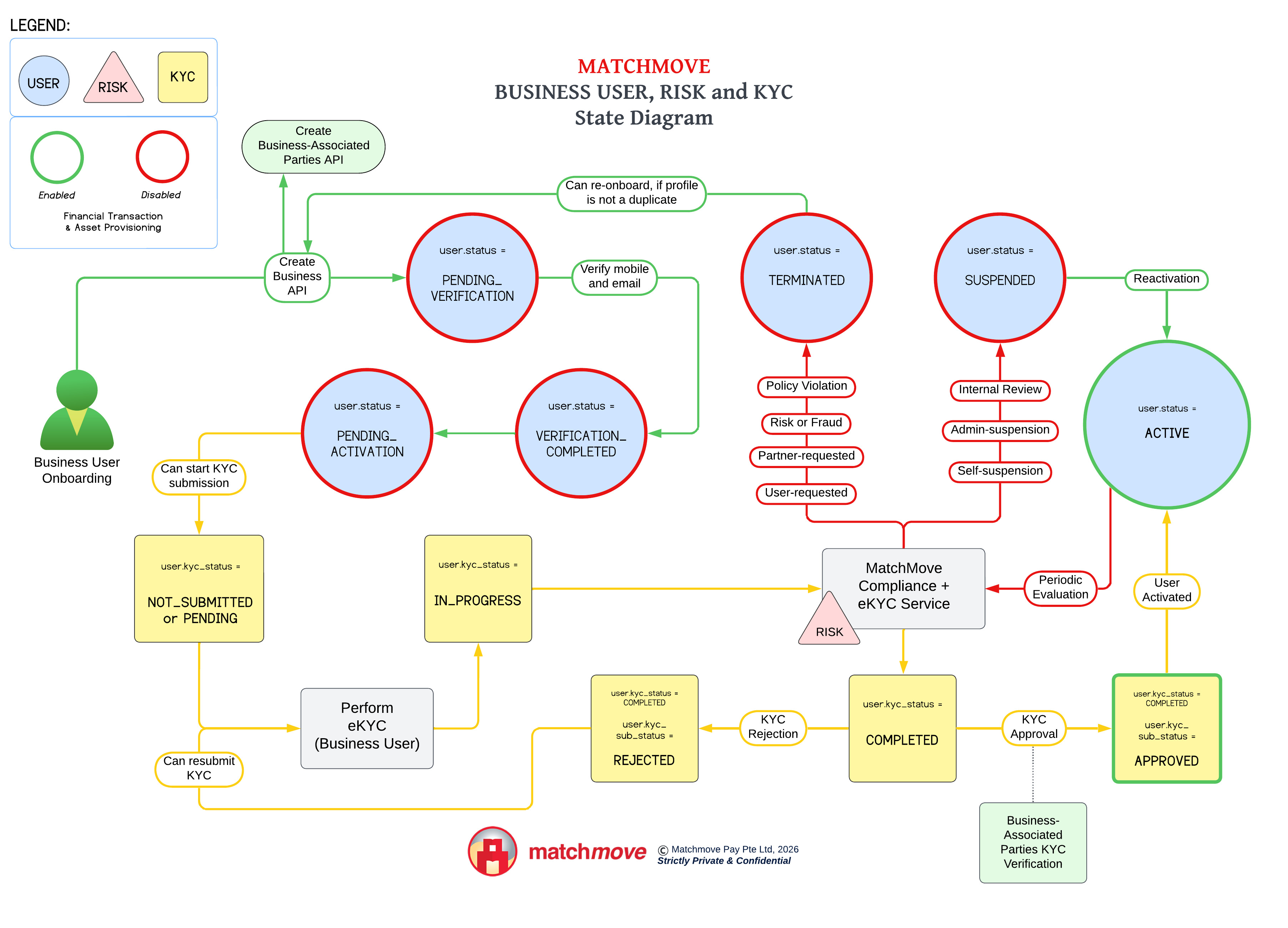
Before a business user is granted access to any financial facilities and capabilities within the platform, the USER, RISK, and KYC must be in an approved or green status. These are the states depicted with a GREEN border:
Business User Definition |
| The business user profile required information is completed |
Risk Evaluation | Risk evaluation is integrated completely into the KYC verification process. No additional risk evaluation status will need to be tracked and handled. | The risk evaluation result did not garner any hits on the business user profile when it was checked against all the available blacklists |
KYC Verification |
| The submitted KYC documents and data authenticated the legitimacy of the information in the business user profile. |
Business KYC Verification
Business Entities
Business user
This business entity is a direct user entity under the program owner or the main partner. This business entity can be associated with another business or individual entity as a parent business.
These entities can own an account and have access to financial services.
e.g.
- Corporate ABC
Sub-business user
This sub-user entity can be a business or an individual that is directly associated as a child of a parent business.
These entities can own an account and have access to financial services.
e.g.
- Corporate ABC (parent)
- Corporate ABC employee (sub-business child)
Business-associated parties
An associated party is not a user entity. They cannot own an account and gain access to financial services. They can either be a business or an individual entity type.
Associated parties are used to define the directors, stakeholders, and other beneficial owners of a business.
These entities are defined in the system to make sure that all parties connected to the business are also verified during customer due diligence.
e.g.
- Corp ABC (business entity) is associated with:
- John Smith (director)
- Corp CDE (majority shareholder)
- Steve Smith (owner)
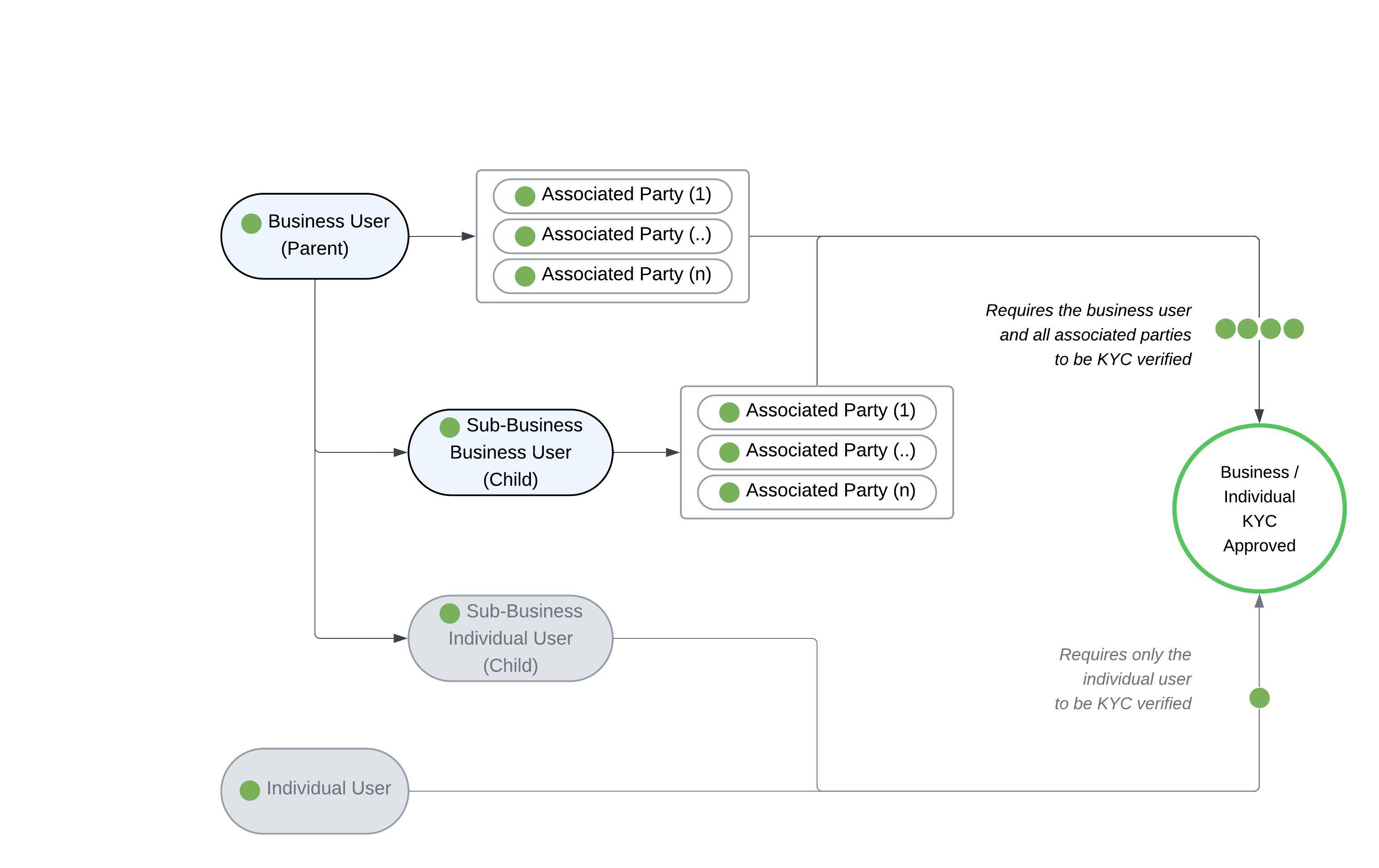
Figure: Business KYC requirement diagram
The diagram below illustrates what a business entity requires before being given a KYC approval:
- The business must pass its own KYC verification.
- All the associated parties linked to a business must also pass each of their KYC verifications.
- The sub-business user (child) entity does not affect the KYC of its parent business.
- The (parent) business user entity will not be able to create a sub-business user (child) unless it gets its KYC verification first.
Upgrading to V2 Identity & Onboarding API from V1?
Here's a complete step-by-step guide to help you — Identity & Onboarding v2 Upgrade.
Related Links


On this page
- [v2] Onboard business users